How Keeping a Reading Log Increased My Hope
It’s been quite a year around here. My family won’t soon forget 2025, not because of all the wonderful things that happened, but because it’s been a year of trouble. Not pesky annoyances like a bad cold or a package getting stolen off the porch – I’m talking about the kinds of life events that make a therapist take a deep breath and wonder where and how to start.
Our family had no control over most of these troubling events. We hadn’t caused them by being lazy or making bad decisions. They just happened, the way problems do sometimes, and to make it worse, the Bad Things seemed to come in clusters. There were moments we thought they would never let up. These were times when it was difficult to keep our hope alive.
A decision for my peace of mind
That doesn’t mean that everything this year was awful. We saw friends; we took trips; we went swimming; we told jokes and gave hugs. Even in a year like the one we’ve had, there were highlights. But one of the best things for me was a simple change I made by myself, for myself, for my own happiness and peace of mind. I started keeping a reading log.
I started the log in February when I could no longer ignore the fact that not only was I spending less time reading, but I was also finishing fewer of the books I started. It wasn’t because the books were bad (although some of them were), or that I was busy (although I was busy).
Part of the problem was the amount of stress I was under. But the biggest problem, I knew, had become my phone. The benefits I was getting from my phone habit weren’t at all proportionate to the time I spent on it. The hours I spent scrolling had started to feel like a bad job that I couldn’t bring myself to quit. Those hours didn’t do anything to make me feel better or more composed – in fact, they often made me feel worse about almost everything.
The Oxford Word of the Year for 2025 was “rage bait” and (judging from my own experience with social media) this was a good choice. To be honest, though, I liked Merriam-Webster’s* word of the year even better – they chose “slop,” which they defined as “digital content of low quality that is produced usually in quantity.” You probably know the type of articles they’re describing. I know I do. I wanted less slop in my life, and more meaningful engagement.
Logging the books I’ve read
One winter afternoon I found an empty notebook with a blue cover, and I wrote “Books Read” on its spine. Then I left it in a prominent place: a corner of the kitchen table.
My system is simple:
- At the beginning of every month, I write down the name of the month (“February 2026”) in my notebook. Whenever I finish a book, I log its title and author. I’m only allowed to log a book if I finish it.
- The books I abandon don’t count. Nor, sadly, do rereads, because my favorite books are like old friends that I revisit often – and I was afraid they would crowd out any new reads.
- Outstanding books get stars and maybe a few words like “Great writing” or “Original”.
- Bad books occasionally get a “Formulaic” or “Meh”.
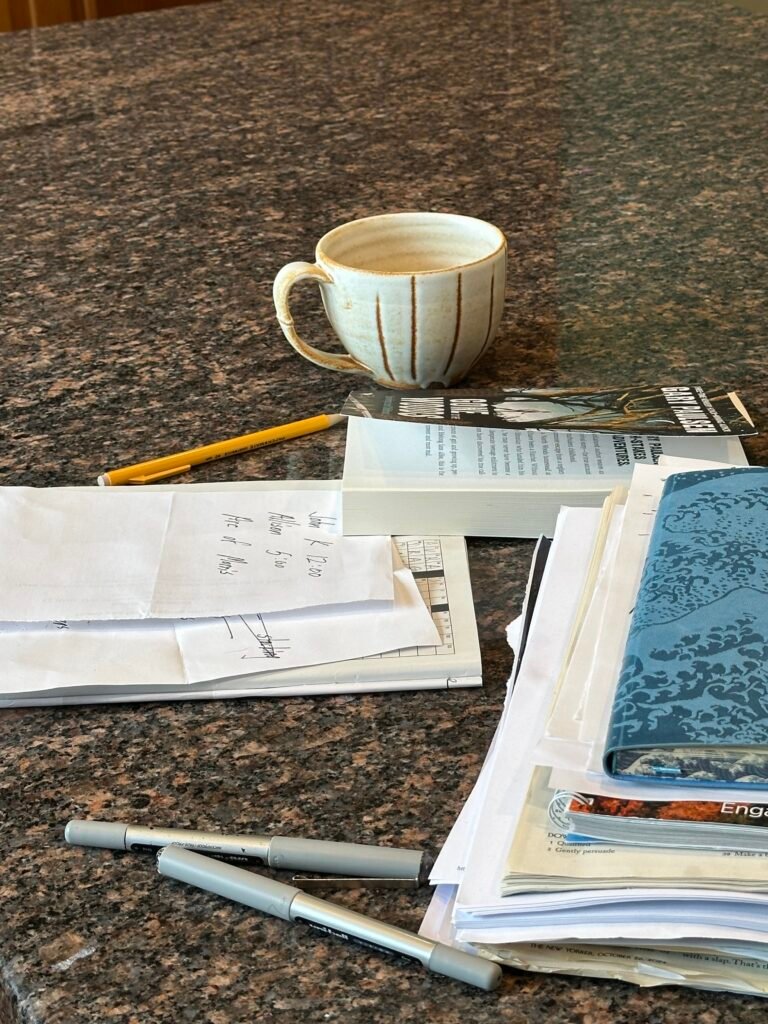
Accountability buddies are all the rage now, and they come in many forms. You can even download an accountability buddy to your phone (although for me that would be a step in the wrong direction). My accountability buddy has a blue cover and lives on my kitchen table and never says a word of reproach. It doesn’t nag. It doesn’t remind me I have fallen short of my goals. For all that, it’s powerful. If I’m getting down to the end of the month, and I’ve only logged a book or two, it’s time to skip a few Star Trek episodes. Instead, I curl up in the corner of the sofa with my latest read.
After nearly a year of record keeping, I’ve found it’s fun to look back over the record, identify trends (for example, I’m a sucker for natural history) and notice areas that could use some shoring up (like contemporary literary fiction). I can’t read everything, but I can always read something; and the reading log is a tangible record of what I’ve accomplished. I think it’s only going to get better as the years go by, and I’m so happy I started it.
Best of all, for me, having a reading log is a hopeful thing. All I have to do is flip through it to remind myself that there have been some real bright spots in the year (like Laura Amy Schlitz’s The Winter of the Dollhouse) and there will be more good reads ahead if I just keep going.
Deciding what you need
A reading log of your own might look different from mine. You could decide to include the books you don’t finish, because you at least gave them a try. Maybe you want to include rereads. Or you might decide to keep the log online or do YouTube videos about it. I don’t think it really matters, as long as you’re encouraging a good habit in yourself.
However, maybe a reading log isn’t the thing you need right now to add meaning, fun, and engagement to your life. And that’s fine, too. Instead, you might choose to:
- reach out to a friend every week, or
- keep your bird feeder full, or
- take a ten-minute walk after dinner.
As 2025 reminded me, we all have challenges in our lives that are beyond our control. Those challenges don’t come when we expect, or end when we want them to. And sometimes the best we can do is to simply endure them. (I had some teachers like that back in school.)
But there are also the things we can choose, and the areas where we can exercise control. These areas might not be big, but the effects can be strong and lasting. Such as the decision to keep a spare notebook with a blue cover and the words “Books Read” on the spine.
Making the smallest positive change often makes everything else feel better, too. It can keep hope alive in the dreariest of times.